
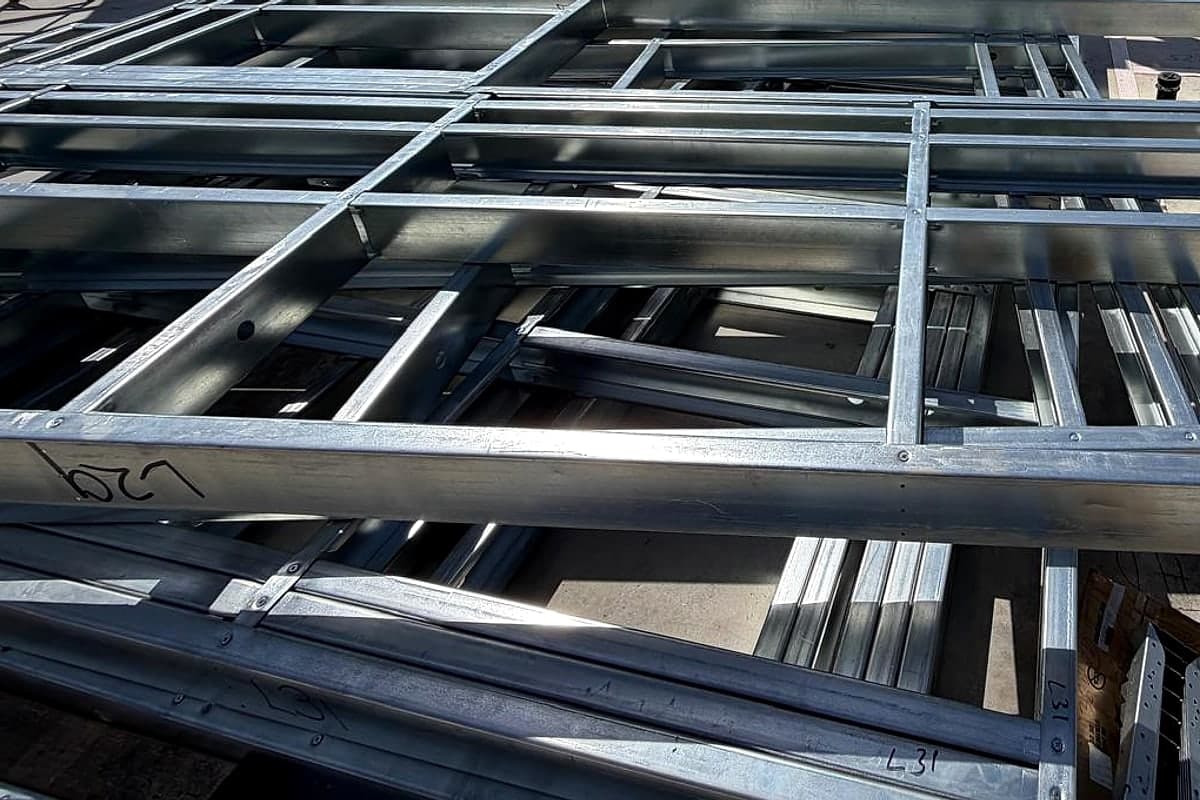
Steel framing library
Metal Stud Gauge Chart: Mils, Gauges and Sizes Explained
Metal stud gauge chart with mil-to-gauge conversion, thickness and color codes, how to read 600S162-54, structural vs. drywall studs, and G40/G60/G90 coatings.
Short answer
Metal stud thickness is specified in mils (thousandths of an inch). Common structural sizes are 33 mils (about 20 gauge), 43 (18 gauge), 54 (16 gauge), 68 (14 gauge) and 97 (12 gauge). Gauge labels are approximate and can mislead, so specify by mils and match the engineer's drawings for load-bearing and exterior walls.
If you have looked at a metal stud chart, you have probably seen the same steel described three ways: by gauge, by mils and by decimal inches. That is the source of a lot of confusion, and in steel framing that confusion can put the wrong stud in a wall. This guide puts the numbers in one place and explains how to read them.
Metal stud gauge chart (mils to gauge)
A mil is one thousandth of an inch. The mil number is the minimum base-metal thickness, before coating, and it equals 95% of the design thickness engineers use in calculations.
| Mils | Approx. gauge | Design thickness (in.) | Minimum thickness (in.) | Color code | Typical use |
|---|---|---|---|---|---|
| 15 | "25 ga EQ" (proprietary) | 0.0155 | 0.0147 | None | Interior nonstructural only |
| 18 | "20 ga EQ" (proprietary) | 0.0190 | 0.0181 | Brown | Interior nonstructural only |
| 27 | 22 | 0.0283 | 0.0269 | Black | Interior nonstructural only |
| 30 | 20 (drywall) | 0.0312 | 0.0296 | Pink | Interior nonstructural only |
| 33 | 20 (structural) | 0.0346 | 0.0329 | White | Lightest structural member |
| 43 | 18 | 0.0451 | 0.0428 | Yellow | Structural |
| 54 | 16 | 0.0566 | 0.0538 | Green | Structural |
| 68 | 14 | 0.0713 | 0.0677 | Orange | Structural |
| 97 | 12 | 0.1017 | 0.0966 | Red | Structural, heavier members |
| 118 | 10 | 0.1242 | 0.1180 | Blue | Structural, heavier members |
Thickness and color values are from the MarinoWARE gauge card and STRUCTURE magazine's jobsite guide, listed below. Color coding is common practice, but always confirm against the stamped marking on the member.
How to convert metal stud gauge to mils
Find the gauge in the second column and read the mil value on the same row, but check which product it is. For structural studs, 20 gauge is 33 mils, 18 is 43, 16 is 54, 14 is 68, 12 is 97 and 10 is 118. For drywall studs, "20 gauge" is usually 30 mils, and "EQ" studs can be thinner still. To decode a full stamp, try our stud decoder.
Why we specify by mils, not gauge
Gauge is an old system that doesn't map neatly onto modern steel framing. "20 gauge" can mean a 33-mil structural stud, a 30-mil drywall stud, or a much thinner proprietary stud marketed as equivalent. Mils are a direct measurement, and they are what codes, engineering standards and stamped drawings use.
Our rule is simple: specify by mils. If a drawing, quote or order uses gauge only, ask for the mil thickness before anything is installed.
How to read a stud designation
Steel framing members carry a standard designation. Using 600S162-54 as an example:
| Part | Example | Meaning |
|---|---|---|
| Web depth | 600 | 6.00 inches, in hundredths of an inch |
| Member type | S | S = stud; T = track |
| Flange width | 162 | 1.62 inches (about 1-5/8 inches) |
| Thickness | 54 | 54 mils minimum base-metal thickness |
Common web depths include 250 (2-1/2 in.), 362 (3-5/8 in.), 400 (4 in.), 600 (6 in.), 800 (8 in.) and larger sizes for joists. Common flange widths include 125 (1-1/4 in.), 162 (1-5/8 in.), 200 (2 in.) and 250 (2-1/2 in.).
Manufacturers stamp members with this kind of information, often adding the steel's yield strength, such as 50 ksi. For an overview of the members themselves, see what light-gauge steel framing is.
Can metal studs be load bearing?
Yes, if they are structural members. Two ASTM standards separate studs that carry building loads from studs that don't.
- ASTM C955 covers cold-formed steel structural framing members, with a base-steel thickness of at least 0.0329 inch (33 mils). These are designed under AISI S240 and S100 and are what you need for load-bearing walls, exterior walls, floors and roofs.
- ASTM C645 covers nonstructural steel framing members for interior construction, such as partitions, soffits and furring. These are designed under AISI S220.
The "20-gauge" and EQ stud trap
This is where mistakes happen. Drywall studs labeled "20 gauge" are typically 30 mils, not the 33 mils of a 20-gauge structural stud. Some proprietary high-strength studs are sold as "EQ" or "equivalent" gauges. One manufacturer's "20 ga EQ" stud is 18 mils, and its "25 ga EQ" is 15 mils.
EQ studs can be a good product for interior partitions. They are not substitutes for structural studs, and they should never end up in a load-bearing or exterior wall. On a jobsite, a pink-marked or unmarked thin stud in a bearing wall is a red flag.
What gauge metal studs for exterior walls?
Exterior walls resist wind pressure and, in most homes, carry floor and roof loads. They need structural C955 members, sized by design.
Under the California Residential Code's prescriptive wall section (R603), stud thicknesses run from 33 to 68 mils. The code calls for steel of at least 33 ksi for 33- and 43-mil members and at least 50 ksi for 54- and 68-mil members. The right choice depends on wall height, stud depth and spacing, wind exposure and loads above. Many homes fall outside the prescriptive limits or use engineered designs anyway, and every load-bearing frame we build is engineered and stamped by a California-licensed engineer.
The practical answer: use what the stamped drawings call for, in mils, with the specified steel strength and coating. Don't substitute a thinner or lower-strength member because it is "the same gauge."
Interior walls and heavy items
Interior non-load-bearing partitions can use nonstructural C645 studs. Interior walls that support floors or roofs are bearing walls and need structural members.
For TVs, cabinets, grab bars and shelving, plan backing before drywall goes up. Steel or wood blocking between studs, or fasteners rated for steel studs and the load, are the reliable options.
Coatings: G40, G60 and G90
Steel framing is protected by a zinc coating applied at the mill. The "G" number is the total coating weight on both sides of the sheet in hundredths of an ounce per square foot: G40 is 0.40 oz/ft², G60 is 0.60 oz/ft² and G90 is 0.90 oz/ft².
| Coating | Where it fits | Code status |
|---|---|---|
| G40 | Nonstructural interior members | Acceptable for nonstructural framing (AISI S220) |
| G60 | Structural framing | Minimum for structural members (AISI S240) |
| G90 | Coastal or high-exposure locations; the coating APB frames with | Exceeds the G60 minimum (50% more zinc) |
ASTM C645 covers interior construction, so lighter-coated drywall studs don't belong in exterior walls. We frame with G90. If your home is near the ocean or has walls that may see more moisture, the project engineer confirms the coating for your site. Whatever coating you choose, the wall still needs good flashing and drainage. A sound coating is part of why a steel frame can't rot and termites can't eat it; see termite-resistant homes in California.
Checking material on the jobsite
Before framing starts, it is worth confirming:
- The stamped designation matches the drawings (depth, flange, mils).
- The steel strength (33 or 50 ksi) matches where specified.
- The coating meets the specification.
- Color marks agree with the stamp. If members are unmarked, thickness can be measured with a micrometer.
Getting it right on your project
The thickness of a stud is one line on a drawing, but it drives strength, cost and code compliance. If you are converting wood-frame plans to steel, the engineer will set member sizes for every wall. Learn how that works on our plan conversion page, compare materials in steel vs. wood framing, check your address for fire hazard and climate zone, or contact us with questions about your plans.
Why homeowners choose steel framing with APB
Getting the stud thickness, steel strength and coating right is what makes a steel frame last, and it is the engineer's job to specify them. We build to the stamped drawings in mils, check the markings on the jobsite and don't substitute thinner members for a matching gauge. For the bigger picture, read why steel framing pays off in California, see how plan conversion works, or contact us.
Common questions
How do I convert metal stud gauge to mils?
Use the chart: 33 mils is about 20 gauge (structural), 43 is 18 gauge, 54 is 16 gauge, 68 is 14 gauge, 97 is 12 gauge and 118 is 10 gauge. A mil is 0.001 inch, and the mil number is the minimum base-metal thickness.
What gauge metal studs should I use for exterior walls?
Exterior walls resist wind and often carry loads, so they need structural studs made to ASTM C955: at least 33 mils (about 20 gauge structural), with a G60 or heavier coating. The exact thickness, depth and spacing come from the engineered drawings.
Can metal studs be load bearing?
Yes. Structural studs made to ASTM C955, 33 mils and thicker, carry floor and roof loads when sized by the code tables or an engineer. Drywall studs made to ASTM C645 are nonstructural and must not be used in bearing walls.
What is the difference between 20-gauge structural and 20-gauge drywall studs?
A 20-gauge structural stud is 33 mils. A 20-gauge drywall stud is 30 mils, and some proprietary 'EQ' studs sold as 20-gauge equivalent are as thin as 18 mils. Only structural studs belong in load-bearing or exterior walls.
What do the color marks on metal studs mean?
Many manufacturers paint stud and track ends by thickness: white for 33 mils, yellow for 43, green for 54, orange for 68, red for 97 and blue for 118. Pink and black mark thinner interior-only members.
Can metal studs hold a TV?
Yes, with planning. Heavy items should be anchored to backing or blocking installed in the wall before drywall, or with fasteners rated for steel studs and the load. Don't rely on drywall alone.
Sources
- 01MarinoWare: Member designation and steel thickness cardmarinoware.com
- 02Structure Magazine: Identifying Cold-Formed Steel Material Thickness on the Job Sitestructuremag.org
- 03ASTM C955: Cold-Formed Steel Structural Framing Membersstore.astm.org
- 04ASTM C645-24: Nonstructural Steel Framing Membersstore.astm.org
- 05CRC Section R603 Cold-Formed Steel Wall Framing (2025 California Residential Code)gocodebook.com
Code references follow the 2025 California Building Standards Code (effective January 1, 2026). Always confirm requirements with your engineer and the local building department for your permit date and address.
Keep reading
More from the library
Are Steel-Framed Houses Bad? Myths vs. Facts
Are steel-framed houses bad? Straight answers on noise, creaking, Wi-Fi, rust, lifespan, termites, mortgages, cost and fire, for California homes.
Read the guide →California's New WUI Code (Title 24 Part 7): What Changed in 2026
Since Jan 1, 2026, California's wildfire building rules sit in a new WUI Code, Title 24 Part 7. What moved, exterior wall paths, and how to check your lot.
Read the guide →Steel Framing for Wildfire Rebuilds: What It Does and Doesn't Do
Steel studs don't burn, but homes ignite from embers and radiant heat. How steel framing fits with the roof, vents, windows, siding, eaves and 5-ft zone.
Read the guide →Next step
Have plans already?
Send your wood-frame plans and your address. We review them and explain what a light-gauge steel frame involves for your home.