
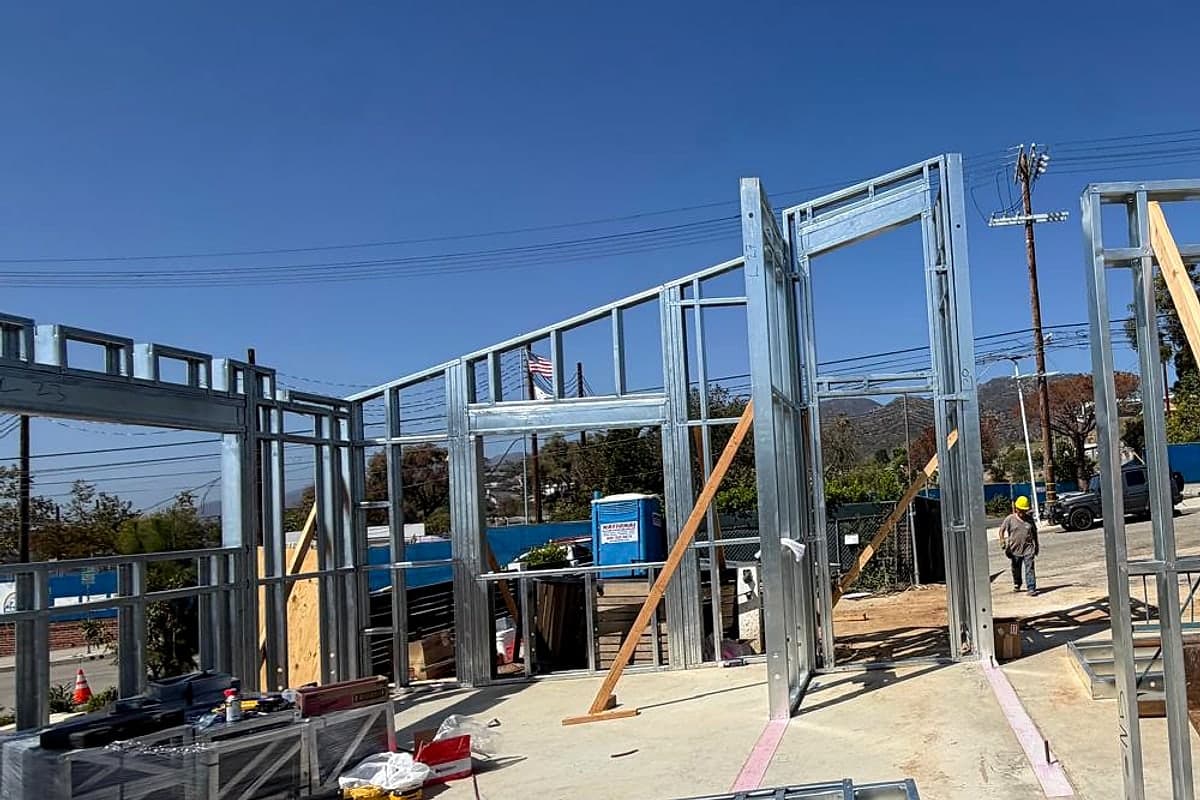
Steel framing library
Termite-Resistant Homes in California: Steel Can't Be Eaten
Can a house be termite-proof? Drywood termites eat wood framing in California; steel framing can't be eaten. What steel removes, what remains and fumigation.
Short answer
No house is fully termite-proof, but a steel frame can't be eaten. Termites cannot digest steel studs, plates or joists, which removes the structure from the menu. Wood trim, roof sheathing, cabinets, doors and drywall paper remain. In Southern California, where drywood termites live inside wood, that changes what you inspect, treat and repair.
Termites are one of the clearest reasons Southern California homeowners look at steel. The reasoning is simple, and the honest version is short: a steel frame cannot be eaten. That does not make a house termite-proof, and this guide explains the difference so you know what steel removes and what you still have to watch.
Can a house be termite-proof?
No. A steel frame removes the structure from the termite menu: the studs, plates, joists and rafters are steel, which termites cannot digest. But a house contains more than a frame.
| Part of the house | In a steel-framed house | Termite risk |
|---|---|---|
| Studs, plates, joists, rafters | Steel | Not edible |
| Wall bracing and roof sheathing | Often OSB or plywood | Wood; still edible |
| Door and window frames, trim, baseboards | Usually wood | Still edible |
| Cabinets and built-ins | Usually wood | Still edible |
| Paper face of drywall | Paper | Can be eaten |
| Sill plates on a slab | Steel track or wood, per the engineered design | Depends on the design |
That is why we say "termite-resistant frame," never "termite-proof house." The reduction in exposure is large, because the frame is the biggest wood component in a conventional house. The rest still needs normal inspections.
Why drywood termites matter in Southern California
According to UC Integrated Pest Management (UC IPM), drywood termites are California's second most important termite pest, after the subterranean termite. They live deep inside wood and are difficult to detect:
- Colonies are rarely seen, except when winged swarmers appear, most often in summer and fall.
- Their droppings are small six-sided fecal pellets, pushed out of tiny kickout holes. Pellets alone can't show whether an infestation is still active.
- The extent of an infestation is hard to judge, so professional inspection is recommended.
Because they eat the wood that holds the house up, a drywood infestation in framing can mean structural repair, not just surface treatment.
Termite fumigation in Los Angeles: what it involves
UC IPM describes whole-structure fumigation with sulfuryl fluoride as highly effective when correctly applied, and monitored fumigation as the most reliable. It requires occupants, pets and plants to leave for several days, depending on the volume of the structure and the amount of gas. Heat treatment is an alternative that needs hours away instead of days, but large beams can be hard to heat fully.
Localized treatments such as liquids, dusts, foams, electrocution, microwaves and wood replacement are available. UC IPM notes that results vary, that localized treatments should be applied only by licensed applicators and that you can never be sure all infestations were reached. Home-use products are not effective.
What does fumigation cost?
There is no regulator price list, and published figures vary widely with house size, company and method. We don't print a number. Get at least three written local quotes for your address, and ask what each covers and guarantees. Then weigh the treatment cost, and the days away from home, against the extra cost of a termite-resistant frame.
Drywood termite house construction alternatives
If you want to reduce termite risk when building, the options are:
| Approach | What UC IPM says | Notes |
|---|---|---|
| Steel framing | Not covered by UC IPM | Frame can't be eaten; wood elsewhere remains |
| Preventive chemicals | No field studies documenting performance on California drywood termites | Effectiveness varies |
| Pressure-treated wood | Listed as a preventive option | Effectiveness varies |
| Barriers | Can degrade and be breached | Must be maintained |
| Resistant wood species | Can be costly and hard to find | Limited availability |
Steel framing is not a UC IPM recommendation, because UC IPM does not address steel homes. It is a physical fact: termites cannot eat steel.
Steel framing also takes away rot and mold food
Steel does not rot, and mold does not grow on the steel itself. Mold feeds on wood, drywall paper and dust. Galvanized framing needs its coating kept intact and the wall dry, so flashing and drainage still matter. We frame with G90, which has 50% more zinc than the G60 structural minimum. For lifespan, see how steel frame houses hold up to rust; for coatings, see metal stud sizes, mils and gauges.
How to build a steel-framed house that is as termite-resistant as possible
- Ask where wood remains. Ask your designer to mark every wood element: sheathing, sill, trim, doors, cabinets, roof parts.
- Choose the exterior thoughtfully. Noncombustible exterior materials such as fiber cement and masonry also fit a fire-hardened design. See steel framing for wildfire rebuilds.
- Keep wood off the soil and the walls dry. Good drainage and flashing protect both steel and the wood that remains.
- Keep inspections going. Follow your lender and local requirements, and have a licensed inspector look periodically.
What this means for the cost of ownership
Termite treatment costs money, and fumigation means days away from the house. A steel frame removes the structure from that risk. In our experience, a frame built from factory-made steel panels comes in close to the cost of a comparable wood frame, and over the years it avoids termite treatment on the structure. Savings vary by house, so we don't claim a payback period. Ask for an estimate on your plans, and weigh it against current fumigation quotes. Our guide to why steel framing pays off in California covers cost honestly, including what steel adds to a budget.
Why homeowners choose steel framing with APB
For a home in termite country, the appeal of steel is making the structure one less thing to inspect and treat. We frame the structure in light-gauge steel, engineered for your site, and we tell you plainly which wood remains so you can plan for it. Learn why steel framing pays off in California, see how wood-to-steel plan conversion works, or contact us to talk through your plans.
Common questions
Can a house be termite-proof?
No. A steel frame removes the studs, plates and joists from the termite menu, but wood trim, roof sheathing, cabinets, doors and the paper face of drywall can still be eaten. Think of it as termite-resistant, and keep normal inspections in place.
Do termites eat steel framing?
No. Termites cannot digest steel, so they can't damage steel studs, plates or joists. They can still tunnel through nearby wood, so it matters what else in the house is made of wood, such as sheathing, trim and cabinets.
How much does termite fumigation cost in Los Angeles?
There is no regulator price list, and published ranges vary widely with house size and company. Get at least three written local quotes and ask what the guarantee covers. Fumigation also means leaving the house for several days.
What are alternatives to wood framing for drywood termites?
Steel framing is the one that removes the frame from the menu. For wood houses, UC IPM lists preventive chemicals, pressure-treated wood, barriers and resistant wood species, but notes limits: no field studies on preventive chemicals for California drywood termites, barriers that can be breached, and costly resistant woods.
Does a steel frame house still need a termite inspection?
Yes. Most steel-framed houses still contain wood in sheathing, trim, doors, cabinets and some roof parts. Follow local requirements for your lender and municipality, and keep periodic inspections going.
Sources
Keep reading
More from the library
Are Steel-Framed Houses Bad? Myths vs. Facts
Are steel-framed houses bad? Straight answers on noise, creaking, Wi-Fi, rust, lifespan, termites, mortgages, cost and fire, for California homes.
Read the guide →California's New WUI Code (Title 24 Part 7): What Changed in 2026
Since Jan 1, 2026, California's wildfire building rules sit in a new WUI Code, Title 24 Part 7. What moved, exterior wall paths, and how to check your lot.
Read the guide →Metal Stud Gauge Chart: Mils, Gauges and Sizes Explained
Metal stud gauge chart with mil-to-gauge conversion, thickness and color codes, how to read 600S162-54, structural vs. drywall studs, and G40/G60/G90 coatings.
Read the guide →Next step
Have plans already?
Send your wood-frame plans and your address. We review them and explain what a light-gauge steel frame involves for your home.