
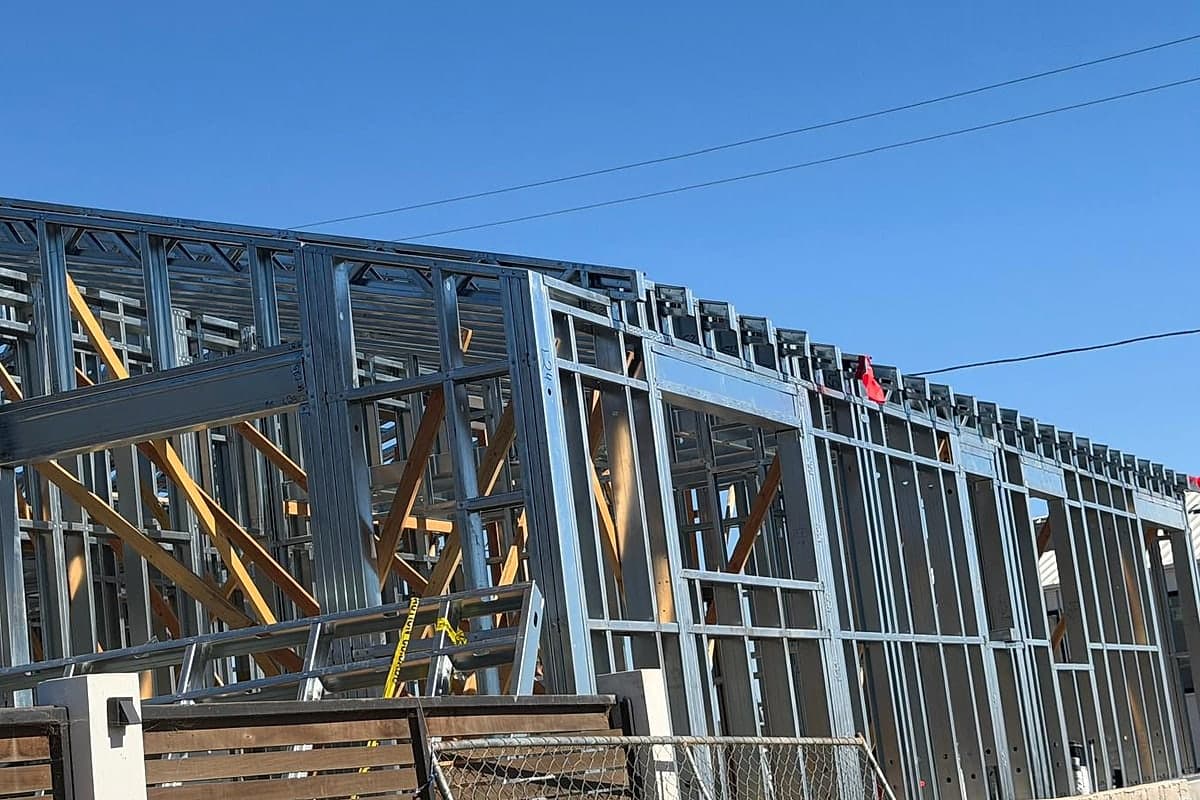
Steel framing library
Are Steel-Framed Houses Bad? Myths vs. Facts
Are steel-framed houses bad? Straight answers on noise, creaking, Wi-Fi, rust, lifespan, termites, mortgages, cost and fire, for California homes.
Short answer
No. Steel-framed houses are not inherently bad, but they are different. The frame is noncombustible, can't be eaten by termites and won't rot or shrink. The real tradeoffs are extra insulation to limit heat loss through the studs, stamped engineering for every frame, and fewer crews with steel experience. In our experience, a frame built from factory-made steel panels comes in close to the cost of a comparable wood frame.
Steel framing makes up a small share of U.S. homes: about 5,000 steel-framed single-family homes were completed in 2025, roughly half a percent of the market and 25% more than the year before, according to NAHB. Because so few people have lived in one, much of what you read online is secondhand. Below are the questions people actually search for, with what is known, what depends on design, and where the evidence is thin.
Myths vs. facts at a glance
| Common claim | What's actually true |
|---|---|
| "Steel houses are noisy." | Sound control depends on the whole wall or floor assembly, not the stud material alone. |
| "Steel frames creak." | Steel doesn't shrink as it dries, a common cause of wood squeaks. Noises depend on detailing. |
| "Steel kills Wi-Fi." | There is little published testing. Studs are spaced with open bays between them; layout and other materials matter too. |
| "Steel framing rusts out." | Framing is galvanized. Inside a dry envelope, industry research predicts a very long coating life. |
| "Termites aren't a concern at all." | The steel frame can't be eaten, but other wood in the house still can. |
| "You can't get a mortgage." | Fannie Mae classes a site-built home with a wood or steel frame as stick-built. |
| "Steel always costs far more than wood." | Older studies found a higher first cost. In our experience, factory-built steel panels come in close to a comparable wood frame. |
| "Steel houses can't burn." | Steel is noncombustible, but contents, roofs, windows and finishes can burn. |
What's actually wrong with steel-framed houses?
Steel has real drawbacks, and it is better to know them up front.
- Heat loss through the studs. Steel conducts heat much better than wood. One analysis based on ASHRAE data found R-19 batts in 2x6 steel studs perform like about R-7.1. Under California's Title 24, that usually means adding continuous insulation outside the studs.
- Added design costs. Engineering and continuous exterior insulation add cost that a wood house may not have. Older published studies found a higher first cost for steel overall: in a 2002 HUD study of two nearly identical homes, the steel home cost 14.2% more. In our experience, a frame built from factory-made steel panels comes in close to the cost of a comparable wood frame.
- Fewer experienced crews. Framers, electricians and plumbers all use different methods with steel. Experience matters.
- More engineering. California's exemption for unlicensed plans covers woodframe homes only, so a steel home needs engineered, stamped plans. That is a step in the schedule.
None of these make a steel home unsafe. They are design and budget issues you plan for. For a full comparison, including a pros and cons list, see steel vs. wood framing for California homes.
Are steel frame houses noisy?
There isn't good public data comparing everyday noise in steel and wood homes, so we won't claim one is quieter.
What is known is that sound ratings (STC for airborne sound, IIC for impact sound) are assigned to tested assemblies, not to studs. Cavity insulation, extra or heavier drywall, resilient mounting, staggered or double studs and sealed gaps around outlets all change how much sound gets through. A steel wall or floor can be designed for good sound control; so can a wood one. If quiet bedrooms or a home office matter to you, say so during design.
Do steel frame houses creak?
Many squeaks in wood houses come from lumber shrinking as it dries, which loosens fasteners over time. Steel is dimensionally stable, so that cause goes away.
Steel does expand and contract slightly with temperature. Inside a conditioned house, that movement is small. Noises that do show up usually come from pipes or ducts rubbing on framing, which is why plumbers use isolators where pipes pass through steel studs. Careful detailing matters more than the material.
Do steel frame houses affect Wi-Fi?
This is a common worry, and the honest answer is that there is little published testing on Wi-Fi in steel-framed homes.
Studs are typically spaced 16 or 24 inches apart with open cavities between them, so a steel wall is not a solid metal sheet. Other materials also affect wireless signals, including stucco over wire lath and foil-faced insulation or sheathing, and those are common in wood-framed California homes too. Router placement, the number of walls between rooms and the size of the house usually matter a lot. If strong coverage is important, plan wired access points or a mesh system during construction.
Do steel frame houses rust?
Steel framing is coated with zinc at the mill. Corrosion needs moisture, and the zinc protects the steel, including at small cut edges and scratches.
What causes rust is water: roof or window leaks left unrepaired, wet crawlspaces, poor drainage and harsh coastal exposure. Good flashing and drainage protect both steel and wood. We frame with G90, which has 50% more zinc than the G60 structural minimum. See metal stud sizes, mils and gauges for coating details.
How long do steel frame houses last?
The Steel Framing Industry Association cites an NAHB Research Center report that predicts galvanized framing installed inside a building envelope can last roughly 300 to more than 1,000 years, depending on exposure. The same source gives shorter estimates for semi-exposed spaces, such as about 100 years in an uninsulated attic.
Those are modeled predictions published by a steel-industry group, so treat them as an indication rather than a guarantee. In practice, the life of any house depends more on keeping water out and maintaining the roof, windows and finishes than on the frame.
Do steel frame homes need termite protection?
The frame has no cellulose: termites can't eat it and it won't rot. That is one of steel's clearest advantages, especially in Southern California, where drywood termites live inside wood and fumigation means days out of the house.
A steel-framed house is rarely steel-only, though. Wall bracing often uses OSB or plywood sheathing, and trim, doors, cabinets and some roof parts may be wood. Follow local requirements and keep normal inspections in place. For the full list of what steel removes and what remains, read termite-resistant homes in California.
Are steel frame houses mortgageable?
Yes. Fannie Mae's guide to eligible housing types defines a stick-built home as one with a standard foundation and a frame made of wood or steel. Because steel homes are uncommon, bring your lender and appraiser into the conversation early, and keep the stamped drawings and inspection records for the appraisal.
Is steel framing cheaper than wood?
Close to it, in our experience: a frame built from factory-made steel panels comes in close to the cost of a comparable wood frame. Older published studies found more, from 14.2% more for a whole home in a 2002 HUD side-by-side test to 30% to 50% more for framing alone in a 2004 trade report, which also noted a large builder reaching rough parity with panelized steel at volume. Tariffs on steel and lumber shift the numbers. Over the life of a house, a steel frame also avoids termite damage, rot and shrinkage cracking in the structure. We don't publish prices; your plans and site drive the cost. See why steel framing pays off in California for where the money can come back.
Do steel studs burn? Is light-gauge steel fire resistant?
Steel studs are noncombustible: they don't burn or add fuel. Fire ratings come from the full wall assembly, and wildfire survival also depends on the roof, vents, windows, siding and the 5-foot zone around the house.
Lab tests published in 2026 found that cold-formed steel can lose up to about 70% of its strength at 600°C, so it relies on gypsum board and other layers to earn a fire rating. No framing material makes a house immune to fire. Research on the 2025 Los Angeles fires found that embers were a common ignition source, and that home hardening and the area right around the house made a large difference: IBHS reported that homes with four hardening features had a 54% likelihood of avoiding damage, versus 36% for homes with only one. Read steel framing for wildfire rebuilds for the full picture.
Should you buy or build a steel-framed house?
A steel-framed house is a sound choice when it is engineered properly, insulated for California's energy code and built by people who know steel. Ask for the stamped drawings, energy compliance documents and inspection records, as you would for any house.
If you are rebuilding or planning a new home, check your address for fire zone and climate zone, learn what light-gauge steel framing is, see how plan conversion works, or contact us to talk through your project.
Why homeowners choose steel framing with APB
Most of the myths above don't hold up for a well-engineered steel house, and most of the real drawbacks (insulation, engineering, trade experience) are things we plan for from the first sketch. The usual reasons to choose steel are a frame termites can't eat and a noncombustible structure. See why steel framing pays off in California, learn how plan conversion works, or contact us.
Common questions
What's wrong with steel-framed houses?
The main drawbacks are heat loss through the studs, which calls for continuous exterior insulation, the stamped engineering every steel frame needs, and fewer trades familiar with steel. Older published studies also found a higher first cost, though in our experience a frame built from factory-made steel panels comes in close to the cost of a comparable wood frame. These are design and budget issues, not safety defects.
Do steel frame houses rust?
Steel framing is galvanized, and corrosion needs moisture. Inside a dry, well-built envelope, industry research predicts a very long coating life. Leaks, wet crawlspaces and harsh coastal exposure are what to design against.
How long do steel frame houses last?
An NAHB Research Center report cited by the steel industry predicts that galvanized framing inside a building envelope can last roughly 300 to more than 1,000 years, depending on exposure. Treat that as a modeled estimate; the real limits are water management and the rest of the house.
Are steel frame houses noisy?
Not inherently. Sound control comes from the whole assembly: insulation, drywall layers, resilient mounting and sealing gaps. A steel wall can be designed for good sound control, just as a wood wall can.
Can you get a mortgage on a steel-framed house?
Yes. Fannie Mae's housing-type guide defines a stick-built home as one with a standard foundation and a frame made of wood or steel. Because steel homes are uncommon, talk to your lender and appraiser early.
Do steel frame homes need termite protection?
The steel frame itself can't be eaten by termites, but no house is termite-proof. Most homes still contain wood in sheathing, trim, cabinets and doors, so follow local requirements and keep up normal inspections.
Is light-gauge steel fire resistant?
Steel studs are noncombustible and don't add fuel, but steel loses strength at high temperatures. Fire ratings come from the full wall assembly, usually with gypsum board.
Sources
- 01NAHB Eye on Housing: Wood Framing Continues to Dominate Single-Family Constructioneyeonhousing.org
- 02Steel Framing Industry Association: Moisture and the Performance of Cold-Formed Steel Framingbuildsteel.org
- 03Steel Framing Industry Association: Durability of Cold-Formed Steel Framing Membersbuildsteel.org
- 04Fannie Mae: Housing types eligible for financing (stick-built, wood or steel frame)singlefamily.fanniemae.com
- 05HUD: Steel vs. Wood Cost Comparison, Beaufort Demonstration Homes (2002)huduser.gov
- 06Builder: Framework for Innovation (Lennar panelized steel, 2004)builderonline.com
- 07Building Enclosure: Effective Insulation R-Values in Steel vs. Wood Framingbuildingenclosureonline.com
- 08IBHS and Headwaters Economics: 2025 Los Angeles Fires Wildfire Home Analysisheadwaterseconomics.org
- 09Wildfire Task Force: Home hardening and Zone Zero in the 2025 LA fireswildfiretaskforce.org
- 10Ozkal et al.: Cold-formed steel under fire: Dual testing and empirical strength modeling (Engineering Structure and Civil Engineering 20(4), 2026)doi.org
- 11IBHS: Findings on LA County's Palisades and Eaton fires (Dec. 10, 2025)ibhs.org
- 12UC IPM: Drywood termitesipm.ucanr.edu
Keep reading
More from the library
California's New WUI Code (Title 24 Part 7): What Changed in 2026
Since Jan 1, 2026, California's wildfire building rules sit in a new WUI Code, Title 24 Part 7. What moved, exterior wall paths, and how to check your lot.
Read the guide →Metal Stud Gauge Chart: Mils, Gauges and Sizes Explained
Metal stud gauge chart with mil-to-gauge conversion, thickness and color codes, how to read 600S162-54, structural vs. drywall studs, and G40/G60/G90 coatings.
Read the guide →Steel Framing for Wildfire Rebuilds: What It Does and Doesn't Do
Steel studs don't burn, but homes ignite from embers and radiant heat. How steel framing fits with the roof, vents, windows, siding, eaves and 5-ft zone.
Read the guide →Next step
Have plans already?
Send your wood-frame plans and your address. We review them and explain what a light-gauge steel frame involves for your home.